Conservative treatment of a herniated disc means treatment without surgery, built on movement: physiotherapy, manual therapy and gradual loading. According to the NHS, a herniated disc slowly gets better in most people within a few weeks, sciatica settles within weeks or months, and surgery is rarely needed. At both MozgásKlinika clinics in District II, Retek utca and Pasarét, a herniated disc is one of the most common problems the physiotherapists treat.
What is a herniated disc, and what is sciatica?
Between the vertebrae are flexible discs. In a herniation, the softer inner material of a disc pushes out through its outer ring and can press on or irritate a nearby nerve root. That is why the pain is not always worst in the lower back: many people feel pain and numbness spreading into the buttock, the thigh or right down to the foot. The same can happen in the neck, where it spreads into the arm.
Sciatica is not a separate disease but a symptom: pain in the buttock and down the back of one leg, caused by irritation of the sciatic nerve. The NHS notes that sciatica can be caused not only by a disc but also by narrowing of the spinal canal or a slipped vertebra. So “it spreads into my leg” does not automatically mean you have a herniated disc.
What are the symptoms?
The NHS lists these symptoms of a slipped disc:
- low back or neck pain;
- numbness or tingling in the shoulder, arm, hand, leg or foot;
- difficulty bending forward or straightening up;
- muscle weakness;
- pain in the buttock, hip or leg if the disc affects the sciatic nerve.
Sciatica pain is usually on one side and can get worse when you move, sneeze or cough. The NHS also notes that some people have a herniated disc without any symptoms.
What raises the risk?
The NHS lists age, strenuous exercise, lifting incorrectly, long periods of sitting or driving, an inactive lifestyle, being overweight and smoking. Several of these can be changed in everyday life.
Can it get better without surgery?
According to the NHS, yes, in most cases: a herniated disc gradually settles with rest, gentle movement and pain relief. After a short rest in the first days, it helps to start moving carefully, for example walking, swimming or yoga; long sitting and lying down should be avoided. Heat packs can ease the pain.
The NICE guideline (NG59) recommends an exercise-based programme for low back pain and sciatica, and manual therapy only alongside exercise. In Hungary, the 2024 low back pain guideline of the Health Professional College gives the national overview. Whether the conservative route is right in your case is for your doctor and physiotherapist to say, based on the examinations; no one can promise a result in advance.
The US MedlinePlus also says that with treatment, most people recover; it lists rest, pain and anti-inflammatory medicines, physical therapy and sometimes surgery among the treatments. A doctor diagnoses a herniated disc with a physical exam and, sometimes, imaging tests.
Do you need an MRI, and what does the report tell you?
According to the NHS, an MRI scan may be done if symptoms persist; NICE says imaging is justified when the result would change treatment, for example when surgery may be an option.
If you have a report, bring it: the physiotherapist looks at it at the start of the session. On its own, though, it does not tell how much your spine can take now, or which movements make your symptoms worse or better. The size of a herniation on an MRI does not always match the pain: the same herniation causes hardly any problem in one person and strong pain in another. So the treatment plan needs a physical examination, which the assessment provides.
When is surgery needed?
According to the NHS, rarely. NICE NG59 recommends referral for spinal surgery when non-surgical treatment has not helped or was not suitable, and imaging findings match the symptoms. The decision is always the specialist’s.
If your doctor recommends surgery, physiotherapy still plays a part: both clinics offer preparation before surgery and rehabilitation after it, following your doctor’s advice. There is a separate article on this.
With a herniated disc, call 112 at once if
- you have numbness around the buttocks, genitals or anus;
- you cannot pass urine, or lose control of your bladder or bowels;
- you lose feeling in one or both legs, or weakness keeps getting worse;
- symptoms appear on both sides;
- the pain started after a serious accident.
These can be signs of rare but urgent nerve involvement; do not see a physiotherapist first. See a GP if the problem comes with fever, unexplained weight loss, a swelling on the back, or is worse at night (NHS).
What does the physiotherapist look at?
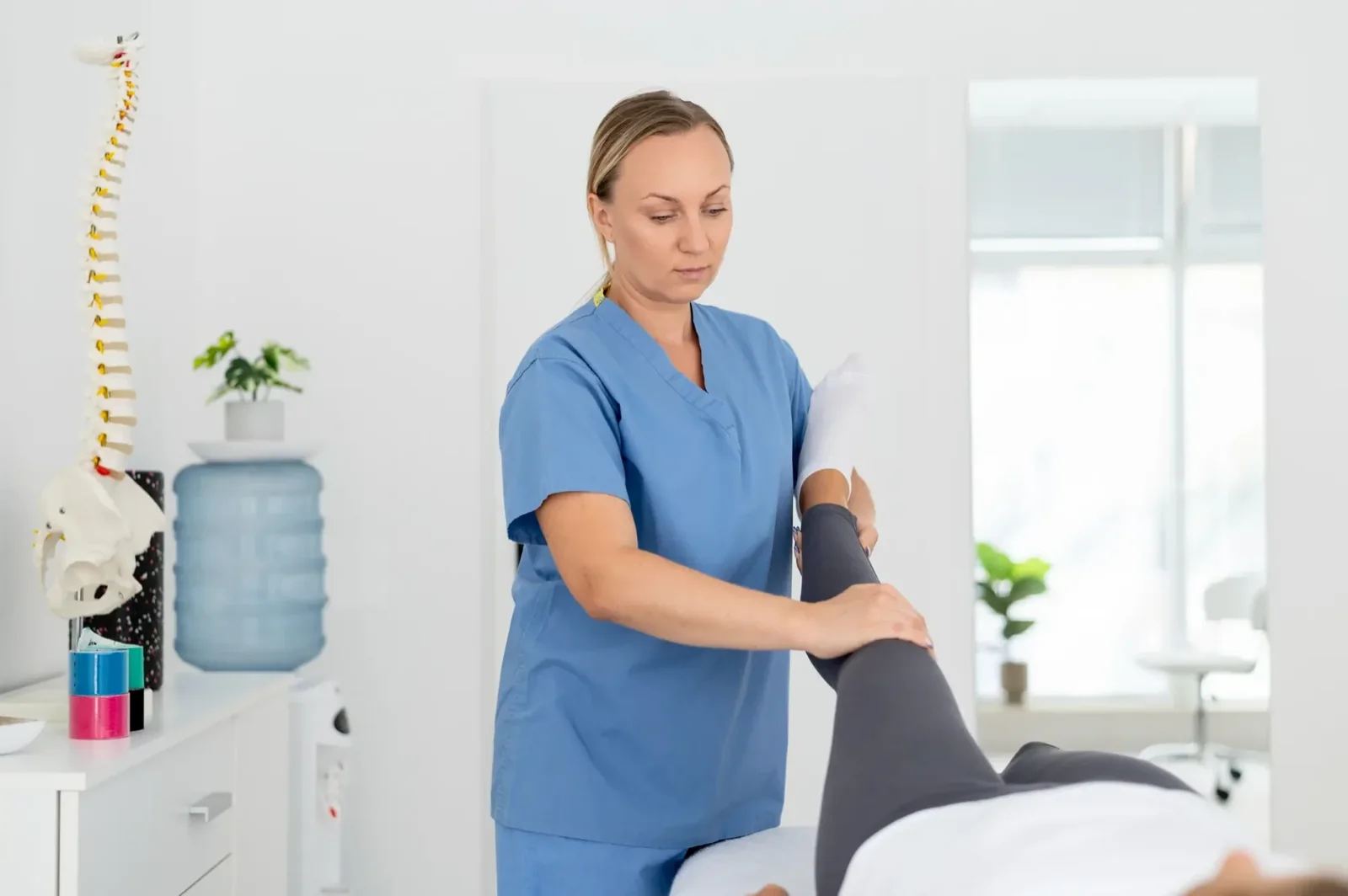
At the assessment the physiotherapist asks about your history and examines range of movement, muscle strength, sensation and reflexes in the leg (in the arm for a neck disc). They check which positions and movements reduce or increase the spreading pain. They also analyse your everyday movements: sitting, bending, lifting.
If the physiotherapist also works with the McKenzie method, they watch how your symptoms change with repeated movements. If the pain in your leg moves back towards the lower back after a movement, that can help choose the direction of treatment.
Who treats herniated discs at the two clinics?
- Retek utca: Deák Borostyán works on conservative treatment of herniated discs, complex rehabilitation aimed at avoiding spinal surgery and preparation for surgery. Rideg Szofi lists conservative treatment of herniated discs and spine stabilisation exercise among her fields.
- Pasarét: Munkácsy Eszter is also trained in the McKenzie method. Franyó Nóra names acute and chronic low back pain with herniated discs and sciatica. Sztányi Borka names herniated discs and manual therapy of the spine, and Pusztai Emese specialised therapy for herniated discs.
How is treatment built up?
The plan follows the levels of the MozgásPiramis®:
| Phase | What is the aim? | What happens? |
|---|---|---|
| early | less pain and less spreading | manual therapy, positions that take load off, physical therapy if needed |
| middle | rebuilding movement and strength | active physiotherapy, strengthening the trunk and hip muscles |
| late | stability and load capacity | practising lifting, bending and carrying, a home programme |
The emphasis is on exercise: NICE also treats exercise-based care as the foundation. Which phase you start in and how fast you progress depends on how you function. You learn the expected length after the examination.
What is the next step?
If pain spreading into your leg keeps coming back or limits you, book an assessment at whichever clinic is closer: Retek utca 26, by Széll Kálmán tér, or Házmán utca 4, by Budagyöngye. The first-visit article tells you what to expect.
If the pain stays mainly in your lower back and does not spread, the low back pain article continues the topic. The related treatments and prices are on the herniated disc page.