In physiotherapy you move, guided by the physiotherapist; in manual therapy the therapist treats your joints and muscles by hand; combined therapy puts both into one session. They are not alternatives but steps that build on each other. At both MozgásKlinika clinics in District II, Retek utca and Pasarét, the assessment decides how much of each you need.
What does physiotherapy mean in practice?
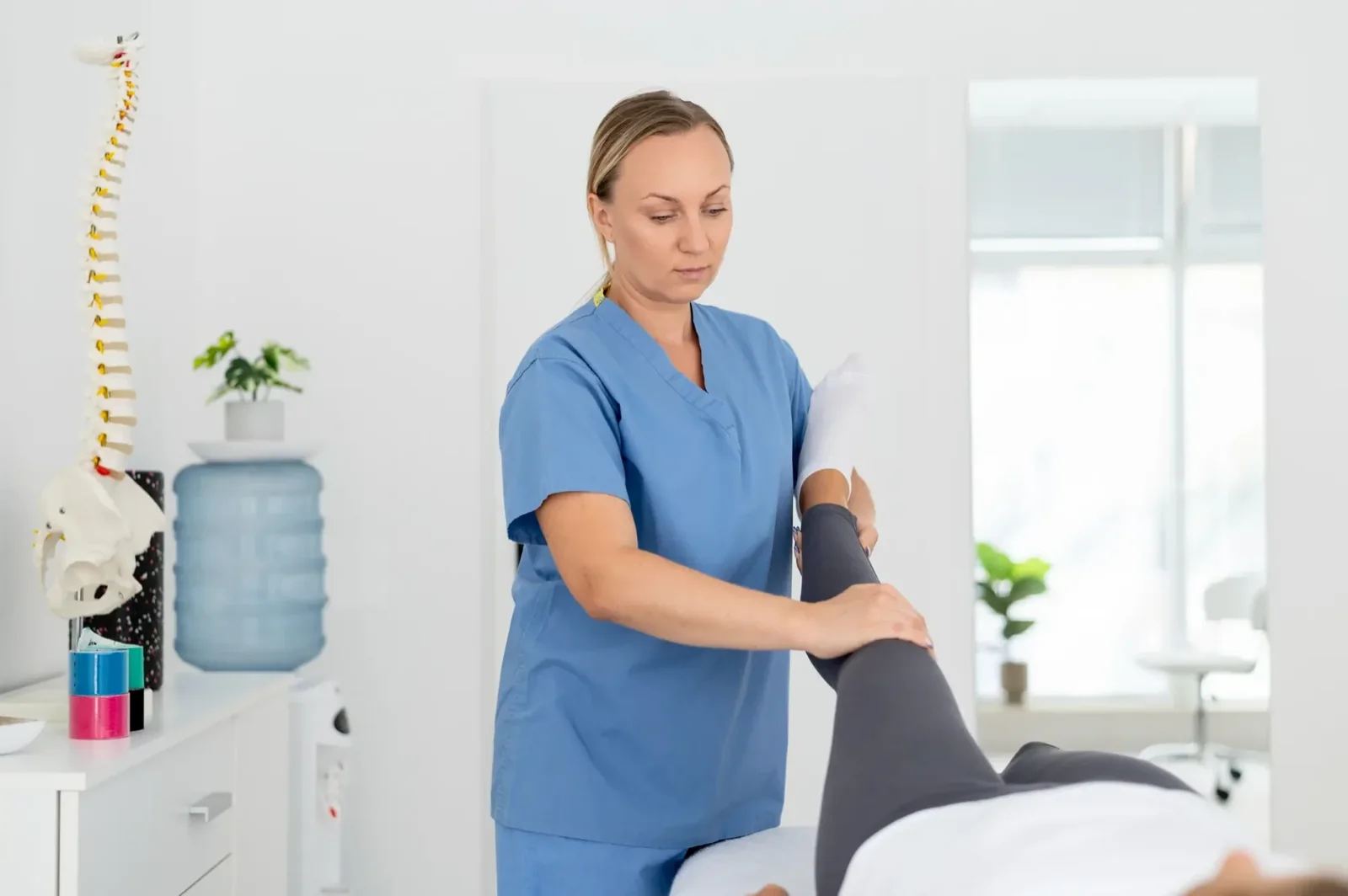
Physiotherapy is the active part. With exercises tailored to you we strengthen and stretch muscles, improve movement patterns, muscle control and stability, and gradually raise the load a joint or a section of the spine can take without symptoms. It is not a printed sheet of exercises: the physiotherapist watches your technique, corrects it and adjusts the difficulty from session to session, depending on how you respond.
The NHS notes that physiotherapists often give exercises to do at home between sessions, and that these work when you do them regularly. That is why sessions leave time to practise the exercises and check your technique, not just to show them.
Length and price: 50 minutes, HUF 22,990.
And manual therapy?
Manual therapy is examination and treatment by hand: passive movement of the joints, soft tissue work and techniques applied while you move. For most techniques you do not need to move actively. The aim is to release joint restrictions, increase range of movement and take load off the affected area.
The therapists at the two clinics have different emphases:
- Retek utca: Rideg Szofi lists soft tissue treatment, trigger point therapy and releasing tight muscles among her fields.
- Pasarét: Munkácsy Eszter studied at Hanze Hogeschool in the Netherlands and trained in the Maitland, McKenzie and Mulligan techniques. Maitland is built on passive joint movement, McKenzie on how symptoms change with repeated movements, Mulligan on hands-on support during movement. Sztányi Borka names manual therapy of the spine, and Franyó Nóra and Pusztai Emese soft tissue manual therapy.
In MozgásKlinika’s approach, manual therapy is not a treatment after which you have nothing to do. It rather “opens a window”: a short period when a movement you have been avoiding is easier, and therefore easier to learn.
Length and price: 50 minutes, HUF 24,990.
Why do the two go together?
Because the guidelines point that way. The British NICE guideline on low back pain (NG59, 2016) recommends manual therapy only as part of a treatment package that includes exercise, not on its own; by manual therapy it means spinal manipulation, mobilisation and soft tissue techniques such as massage. The NHS back pain page lists physiotherapy, group exercise and manual therapy among the possible treatments.
The WHO’s 2023 low back pain fact sheet highlights physical therapies, education and lifestyle changes, and does not treat painkillers as the first choice. In Hungary, the 2024 guideline of the Health Professional College covers the diagnosis and treatment of low back pain.
The logic is simple: hands-on treatment can create a better starting point, for example by easing stiffness or improving range of movement, but the change also has to be fixed in movement. Load capacity is rebuilt through exercise.
What is combined therapy?
Combined therapy is a 50-minute session for HUF 24,990, the same as a manual therapy session. Both clinics offer it in two forms:
| Form | What happens in the session? |
|---|---|
| Physiotherapy combined with manual therapy | hands-on treatment, then active exercise |
| Physical therapy combined with manual therapy | hands-on treatment, supplemented by device-based physical therapy (for example TENS, ultrasound or kinesiology tape; at Pasarét also cupping) |
Neither clinic offers physical therapy on its own, only in this combined form. On the booking page the category is called “Kombinált terápia” at Retek utca and “Kombinált terápiák” at Pasarét. The physical therapy article describes the devices in detail.
How much do they cost in 2026?
Prices are the same at both clinics (October 2026):
| Treatment | Length | Price |
|---|---|---|
| First consultation (assessment) | 60 min | HUF 24,990 |
| Physiotherapy | 50 min | HUF 22,990 |
| Manual therapy | 50 min | HUF 24,990 |
| Combined therapy | 50 min | HUF 24,990 |
The full list is on the prices page; the prices article covers passes and payment.
Which should you choose when booking?
If you have not been to us before, neither: for your first visit the first consultation is the right choice, because treatment always starts with an assessment. The physiotherapist looks at your range of movement, strength and movement patterns and recommends on that basis. The same symptom can come from different problems, so where it hurts does not decide:
- if a joint’s movement is very restricted, there may be more hands-on treatment at the start;
- if movement is free but strength or control is missing, treatment may even start with physiotherapy alone.
The plan follows the levels of the MozgásPiramis®, so the balance changes as you go. On the lower levels, where the aim is to ease pain, there is more hands-on work; higher up, active exercise takes over. The MozgásPiramis® article describes the levels, and this article prepares you for the first visit.
Does manual therapy hurt?
Some techniques can be uncomfortable, especially on a sensitive, tight area, but pain is not the aim. Say if something is too strong: the therapist adjusts the pressure to you. Mild, muscle-ache-like soreness for a few hours after treatment can happen. If the pain is worse after a session, tell the therapist next time, so they can adjust the technique.
According to a summary by the NCCIH, part of the US NIH, temporary mild-to-moderate side effects, most often increased pain or discomfort, stiffness or headache, often occur after spinal manipulation or mobilization, and most go away within 24 hours. Serious side effects have been reported but are very rare; the NCCIH therefore stresses that practitioners should assess patients thoroughly and that patients should share information about their health.
When is neither the right choice?
See a doctor first, then come for treatment
- strong pain, swelling or deformity after a recent accident;
- if you have a fever with the problem, or are losing weight without explanation;
- weakness or spreading numbness in an arm or leg;
- known osteoporosis, cancer or a bleeding disorder that your doctor has not yet commented on.
Always mention these at the examination. In an emergency, call 112.
Prices checked in October 2026. For low back pain, this article, and for neck problems, this one, show how treatment comes together in practice.