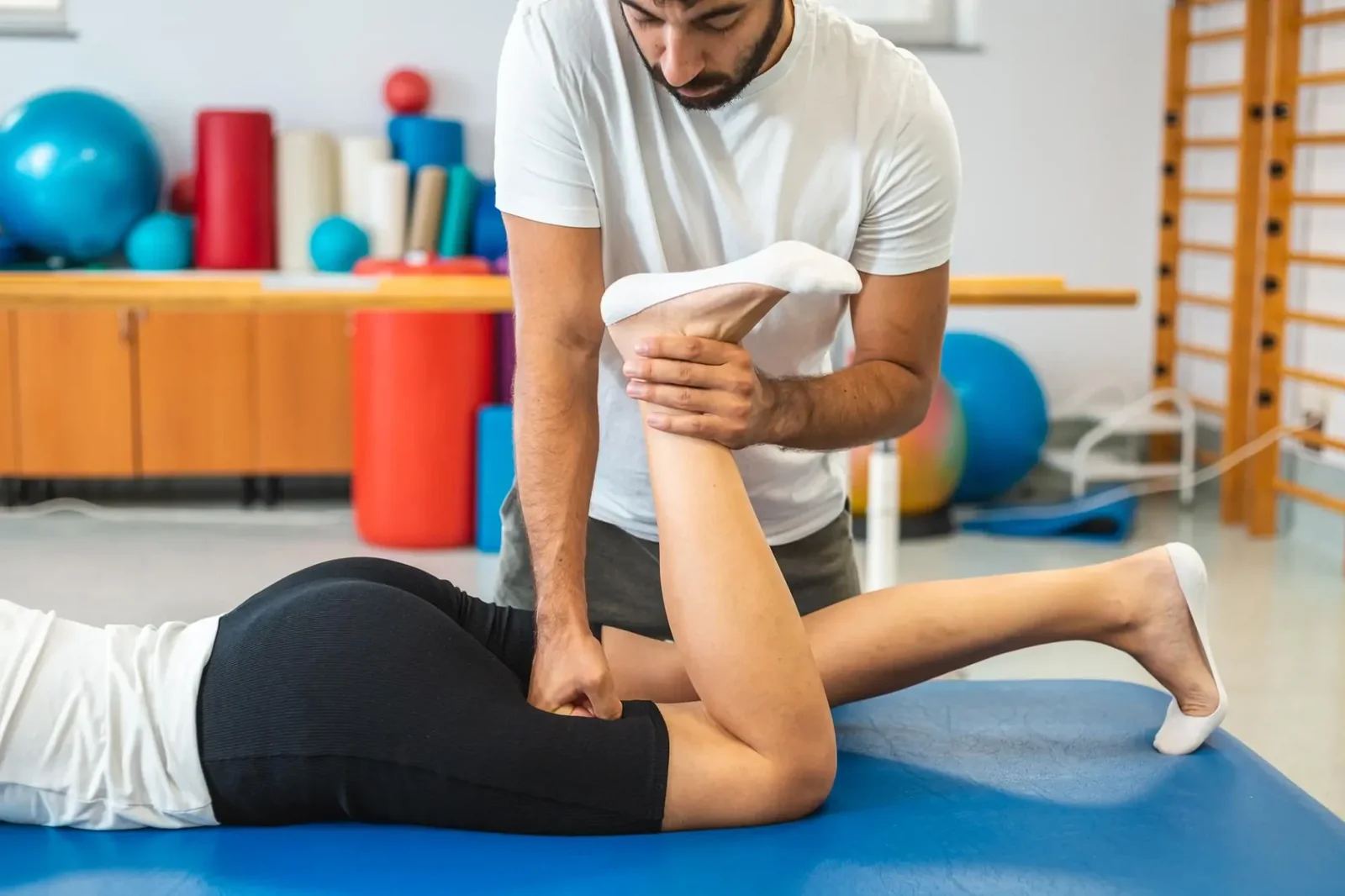
Knee pain can often be treated at home: the NHS expects improvement within a few days, and a GP visit if it is no better within a few weeks. A physiotherapist can help when pain keeps returning, comes under load, or the knee needs rebuilding after injury or surgery.
Why can a knee hurt?
According to MedlinePlus, from the US National Library of Medicine, knee problems are very common and occur in people of all ages. The knee is made up of bone, cartilage, ligaments and fluid, moved by muscles and tendons; when any of these is hurt or diseased, the result can be pain and difficulty walking.
The NHS groups the possible causes in two:
- after an injury: sprains and strains from overstretching, overuse or twisting; tendonitis after repetitive running or jumping; a torn ligament, tendon or meniscus, or cartilage damage, if the knee is unstable, gives way or will not straighten;
- with no obvious injury: osteoarthritis, bursitis, gout or a joint infection, and in teenagers, for example, Osgood-Schlatter’s disease.
The NHS adds that the list is only a guide and that you should not self-diagnose. MedlinePlus notes that the anterior cruciate ligament (ACL) is usually injured by a sudden twisting motion, a common sports injury.
What should you know about knee osteoarthritis?
MedlinePlus names osteoarthritis as the most common disease affecting the knee, with the cartilage gradually wearing away. The NHS describes it as a long-term condition that cannot be cured, but does not necessarily get worse over time and can sometimes gradually improve. MedlinePlus also stresses that not everyone has pain and that a lot can be done to manage the symptoms.
The 2026 Hungarian professional guideline on knee osteoarthritis wants the early stage treated mainly in primary care, with proper patient education, lifestyle change and physiotherapy. Among non-surgical options it lists physiotherapy, an active lifestyle and weight loss. What is right for you is decided by your doctor and physiotherapist together.
What can you do in the first days?
As a first step, the NHS suggests putting as little weight as possible on the painful knee, for example by avoiding standing for a long time. For ice packs and pain relief, see the NHS knee pain page; take medicines as a pharmacist or doctor advises. A reassuring detail from the NHS: painless clicking in the knee is normal.
We give no exercise routine here: when and how much load suits your knee is what the examination shows.
What does the physiotherapist examine?
The 60-minute assessment starts with a conversation: when the pain began, whether there was an injury, which movements (stairs, squatting, running, long sitting) make it worse, and what your goal is. Then comes the physical examination:
- bending and straightening the knee, any swelling and the painful spots;
- strength of the thigh and hip muscles, which also affect how the knee is loaded;
- the position of the foot and ankle when walking and standing on one leg;
- movement patterns, such as how you squat or step down a stair.
Bring any X-ray, MRI or ultrasound reports, or a discharge summary from an operation. If the findings call for a medical work-up, the physiotherapist will say so.
Who works with knee problems at the two clinics?
- Retek utca: Deák Borostyán and Rideg Szofi list treating knee pain and rehabilitation after surgery among their fields.
- Pasarét: Sztányi Borka names hip and knee exercise, and Munkácsy Eszter rehabilitation of shoulder and knee injuries and sport-specific physiotherapy.
Which treatment may be suggested?
You get the recommendation after the examination, and treatment starts at the first visit. For the knee, physiotherapy is most often the main element: gradually rebuilding the strength of the muscles around the knee, movement control and load tolerance. Manual therapy can complement it, and for athletes sports physiotherapy can help prepare the return. The number of sessions cannot be promised in advance.
If the knee problem follows an operation, the article on rehabilitation after surgery helps; after a sports injury, see the article on returning to sport. If your hip hurts too, read the article on hip pain.
When is knee pain urgent?
With knee pain, do not wait for physiotherapy if
According to the NHS, get medical advice now (your GP or an out-of-hours service) if:
- the knee is very painful, you cannot move it, or you cannot put weight on it;
- it is badly swollen or has changed shape;
- it locks, gives way or clicks painfully;
- you have a very high temperature (or feel hot, cold or shivery) with redness or heat around the knee: this can be a sign of infection.
In an emergency, call 112.
What is the next step?
If knee pain keeps returning, or you cannot get back to your usual activity after an injury, book an assessment at the Retek utca or Pasarét clinic, with no referral. Treatments and prices are on the knee pain page.